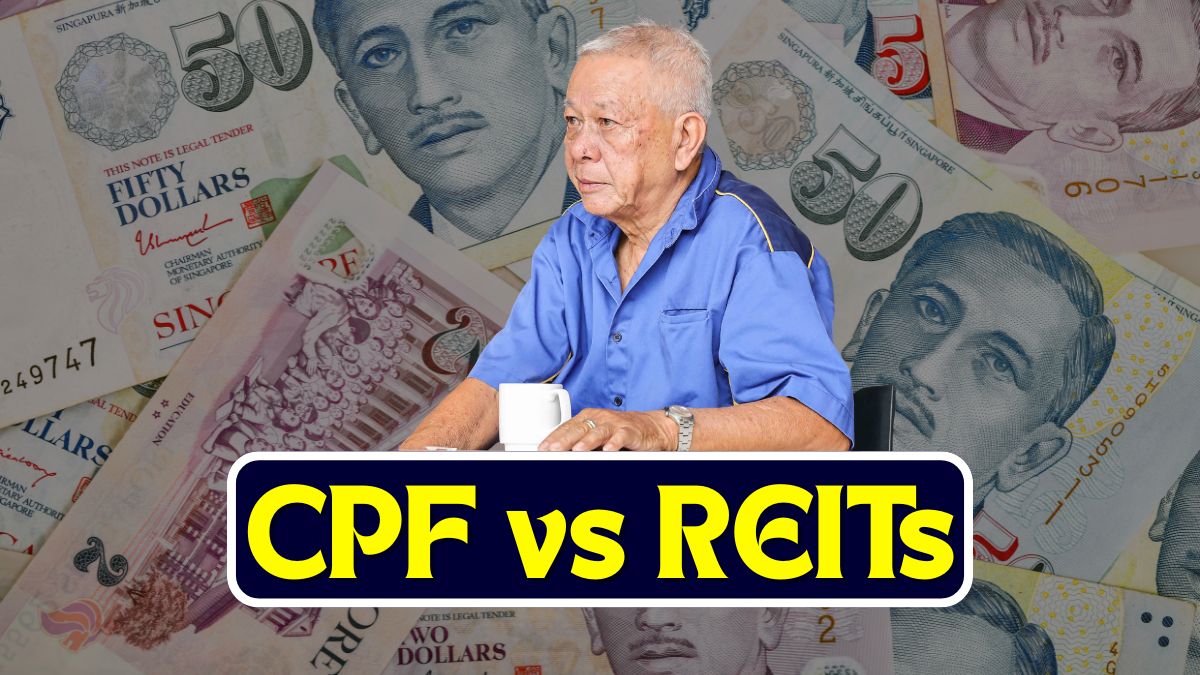
KEY HIGHLIGHTS
- CPF offers guaranteed, lifelong retirement income, while S-REITs provide higher but variable payouts.
- In 2026, CPF interest rates remain stable at up to 4% p.a., while S-REIT yields range around 4–7%.
- Most Singaporeans benefit from combining CPF for essentials with REITs for inflation protection.
As retirement planning becomes more complex in 2026, many Singaporeans are reassessing whether CPF alone is sufficient, or if REITs should play a larger role.
This guide provides a clear comparison to help you plan a reliable retirement income stream.
CPF and REITs 2026
| Feature | CPF (OA/SA/RA & CPF LIFE) | Singapore REITs (S-REITs) |
|---|---|---|
| Typical Returns | 2.5%–4.0% p.a. (guaranteed) | 4%–7% p.a. (variable) |
| Risk Level | Very Low | Moderate |
| Income Stability | Guaranteed for life | Depends on market conditions |
| Liquidity | Low (locked till retirement age) | High (tradable on SGX) |
| Inflation Protection | Limited | Moderate to Good |
Understanding CPF as a Retirement Income Tool
CPF is structured to provide security, predictability, and longevity protection.
CPF Interest Rates (2026 Framework)
CPF interest rates remain government-backed and stable:
- Ordinary Account (OA): 2.5% p.a.
- Special Account (SA): 4.0% p.a.
- Retirement Account (RA): 4.0% p.a.
- Bonus interest of up to 2% on the first S$60,000
These returns are risk-free and unaffected by market volatility.
CPF LIFE: Lifetime Income Security
At retirement age, savings are channelled into the Retirement Account and used to provide monthly CPF LIFE payouts for life.
This ensures:
- No risk of outliving your savings
- Stable monthly income
- Strong peace of mind for essential needs
Where CPF Falls Short
CPF is designed for adequacy, not abundance.

Key constraints include:
- Limited access before retirement age
- Returns focused on preservation rather than growth
- Monthly payouts may not fully cover rising healthcare or lifestyle costs
How REITs Generate Retirement Income
Singapore REITs own income-producing assets such as malls, offices, hospitals, logistics hubs, and data centres.
Why Retirees Use REITs
Under Singapore rules, REITs must distribute at least 90% of taxable income, resulting in:
- Regular cash distributions
- Attractive yields compared to bonds or deposits
- Tax-free payouts for individual investors
Typical REIT Income Profile
- Average yields: 4%–7% p.a.
- Income driven by rental cash flow
- Potential for growth through rent escalation and acquisitions
However, payouts are not guaranteed and can fluctuate with economic conditions.
Income Stability vs Income Growth
CPF: Stability First
CPF provides:
- Guaranteed interest
- Zero market volatility
- Lifetime income certainty
The trade-off is limited protection against long-term inflation.
REITs: Growth with Risk
Well-managed S-REITs can grow distributions over time, helping maintain purchasing power.
However, they remain exposed to:
- Interest rate movements
- Economic downturns
- Short-term price volatility
Why This Matters
Singaporeans are living longer, with retirements often lasting 25–30 years.
Relying on only one income source increases risk:
- CPF alone may struggle against inflation
- REITs alone may feel stressful during market downturns
A blended approach helps manage both financial and emotional risks.
Using CPF and REITs Together
A practical strategy many investors adopt:
- CPF as the income foundation
Covers daily living and essential healthcare - REITs as income enhancement
Supports lifestyle spending and inflation protection
This reduces reliance on any single system.
Illustrative Allocation by Life Stage
- Younger investors: Growth-focused with higher REIT exposure
- Pre-retirees: Balanced CPF and REIT mix
- Retirees: CPF for core needs, REITs as supplementary income
What Singapore Investors Should Know in 2026
Retirement income planning is no longer about choosing between safety or returns.
It is about balancing certainty with flexibility.
CPF provides lifelong stability.
REITs offer higher income potential.
Together, they create a resilient retirement strategy.

[Link to Official Source – Apply Here]
Frequently Asked Questions (FAQs)
Is CPF enough for retirement in Singapore in 2026?
CPF generally covers basic needs, but many retirees use additional income sources to support lifestyle and healthcare costs.
Are REITs safer than stocks?
REITs are typically less volatile than growth stocks, but still subject to market and interest rate risks.
Are CPF LIFE payouts guaranteed?
Yes. CPF LIFE payouts are guaranteed for life and backed by the Singapore Government.
Are S-REIT dividends taxable?
No. Distributions are tax-free for individual Singapore investors.
Should retirees invest CPF money into REITs?
This depends on risk tolerance. CPF is best used for essential income, while REITs suit discretionary funds.
Sources (Official Singapore Government Websites)
- Central Provident Fund Board – https://www.cpf.gov.sg
- CPF LIFE Scheme – https://www.cpf.gov.sg/member/retirement-income/cpf-life
- Monetary Authority of Singapore – https://www.mas.gov.sg
- Ministry of Manpower (Retirement Policies) – https://www.mom.gov.sg